
You have seen what is getting between the click and the call. The only question left is whether fixing it puts more booked jobs on the board for the same money. We build the first agreed fix in week one, measure it against your own call volume, and keep going from there.
No slides · published agenda · no Google Ads account audit · no follow-up drip if you pass.
If your area is still open, it's yours. We agree the territory before you join and hold it for as long as you stay — and we check yours on the call, before either of us commits. The founding rate is for the members who come in first — it moves to $3,000 at ten members and $3,500 at twenty.
Don't have a teardown yet?
Real findings on your actual site, in 48 hours — usually much faster. Yours to keep whether we ever speak or not.
No call required. No pitch deck. If you'd rather just take the report and fix things yourself, that's genuinely fine — it's yours.
See a real teardown first →
A click is only potential. The page still has to make the right homeowner feel understood, trust you, and take the next step.
That's how long the main content took to appear on a phone, on the page their emergency ads pay to fill — 32 seconds of blank screen first. At $30–80 a click, most of that spend never saw the offer at all. Their page weighs 9.9MB. Ours weighs 21KB. Read the whole teardown →
Every missed booking makes the next customer more expensive to acquire.
That narrows the services, keywords and towns you can chase at a profit. Over time it makes growth harder to plan.
The customer searches for one problem and lands on a generic company page.
Relevance leak"Fast, reliable and local" gives the homeowner no reason to choose you now.
Trust leakNo pricing context, process reassurance or proof near the call action.
Action leakThe page launches once, then sits unchanged while the same losses repeat.
Learning leakThe difference between the strongest and weakest salesperson is rarely a few percentage points. It is measured in multiples. Landing pages behave the same way.
I know this from thousands of face-to-face appointments and two decades of conversion work. The page is the salesperson you paid to put in front of the customer. Some clarify the decision. Others quietly lose it.
An individual plumbing company cannot optimise its landing pages anywhere near as quickly as a well-coordinated group operating under one specialist agency. That advantage only works when every member follows the same compact.
Every teardown, page, test and lesson deepens the same category knowledge. We do not dilute the system across unrelated industries.
Rule 01 · Specialist focusWe agree your territory before you join. Once you join, we do not accept a direct plumbing competitor inside your territory.
Rule 02 · Local protectionMembership requires agreement to contribute relevant conversion learning back to the group and to receive lessons discovered elsewhere. No passengers. The system improves because every member participates.
Rule 03 · ReciprocityYou must agree to the protected-territory and reciprocal-learning terms before we accept your business into the agency. The operating agreement will define which findings are shared, how they are handled and what remains confidential to your company.
We do one thing for one trade, because that's what makes the machine fast (see the next section). If you're an independent plumbing company putting $1,000 a month or more into Google Ads — in any town or city in the United States — you're who this is built for. The markets below are simply where we see the most waste today; your area counts whether it's on that list or not.
One plumbing company per area, at a time. We agree your area before you join. While you're with us we will never work with your competitor inside it. The rule works both ways: it protects you while you're here, and the area reopens if you leave.
We analysed more than 8,500 active and historic plumbing advertisers, then used our testing engine to isolate roughly 2,200 with the clearest conversion opportunities.
Every company in the selected cohort showed at least three issues against our Google-derived landing-page rubric. The average was five. Some had eight to ten.
Spending more did not remove the problem. One advertiser we assessed at roughly $18,000 a month still triggered nine separate issues. Another at a similar level triggered eleven.
Cohort findings describe the deliberately selected opportunity group, not every plumbing company. Speed and conversion checks are recorded against a documented assessment rubric derived from Google's published landing-page guidance.
Research population: more than 8,500 active and historic plumbing advertisers and their publicly accessible landing-page journeys.
Selection: companies filtered into the opportunity cohort through a repeatable landing-page assessment engine.
Issue rubric: speed, mobile experience, relevance, message continuity, trust, navigation and conversion-path checks derived from Google's published landing-page guidance.
Evidence pending: the complete rubric, testing dates, metric definitions and source captures will be linked here before publication.
This is the part nobody else will show you, so here it is in full.
The typical plumbing advertiser we measured spends about $4,100 a month at about $13 a click at market rates. That's roughly 315 visits a month — a good business, but a terrible laboratory. To know whether a change genuinely helped, rather than got lucky, you need a certain number of visitors. Fewer visitors, longer wait:
| Testing this way | Visitors needed | How long you'd wait |
|---|---|---|
| Your site alone, testing everything at once | ~20 per combination, per month | Never a real answer |
| Your site alone, one change at a time | ~1,500 per version | About 9 months |
| Thirty plumbing companies running the same test | the same ~2,900, gathered 30× faster | About 9 days |
Same test, thirty markets, no two of you competing. The answer that takes nine months on your own arrives in nine days — and then gets applied to all thirty pages at once.
How we work that out: detecting a genuine 50% improvement on a page converting at 5% needs about 1,470 visits per version — roughly 2,900 in total — at 95% confidence and 80% power. Alone at 315 visits a month that is about nine months. Across thirty companies at the same rate it is about nine days. Smaller improvements need more traffic and take proportionally longer, which is the whole point. One caveat we would rather state than hide: thirty companies are not one homogeneous sample — different markets, brands and offers add variation, so treat nine days as how quickly the evidence accumulates, not as proof delivered. What makes it powerful is replication: a pattern that holds in market after market is stronger evidence than one that worked once.
You give us permission to apply what we learn from other plumbing companies to your pages, and what we learn from yours to theirs. Never your data, your customers, your prices or your numbers — only what worked: "the shorter form beat the longer one", "this headline out-pulled that one".
It's safe because of the one-per-area rule: no one in the group competes with you. A plumber in Nashville learning that a callback promise works isn't taking anything from a plumber in Tampa. And it means you inherit thirty companies' worth of testing instead of your own.
Every member contributes to a coordinated plumbing conversion system. We use lessons discovered across the group to choose better starting hypotheses, then measure what actually performs for your services, customers and protected territory.
We inspect the Google Ads landing-page URLs already identified in our research and find where the public-facing conversion journey breaks down.
01 · DiagnoseWe rebuild the highest-value weak points around the customer, service and search that brought them.
02 · RebuildWinning page messages can later inform ad messaging. Your initial teardown remains strictly focused on the landing pages.
03 · ImproveWe share the conversion lesson: the question, message, proof pattern or page change that improved a decision. We do not share your customer data, prices, call recordings, commercial numbers or identifiable company information with another member. This is not copy-and-paste optimisation — members share conversion lessons, not identical pages. Group evidence tells us where to look first. Your local performance decides what stays.
Everything the teardown found, biggest dollars first: speed, tap-to-call, the first screen, the forms. These are the big, obvious wins and they land fastest.
first fix live in week onePatterns already supported across the other plumbing companies are adapted to your pages and measured against your own results. Not everything transfers — but you skip paying to discover what does, and that is the part you can't buy anywhere else.
inherited, not guessed"Emergency plumber", "water heater repair", "burst pipe" — each gets its own page built to Google's own landing-page guidelines, instead of everything landing on your homepage.
where the compounding startsYour pages join the rotation: the same test runs across many markets at once. A pattern that holds in market after market is far better evidence than one that worked once — and what survives is adapted to your pages and measured against your own numbers. Plus a monthly competitor watch and a fresh waste audit.
monthly, ongoing24/7 AI call answering on your existing number. Prescribed only if your call data shows you are missing calls — never sold as standard.
℞ evidence-led add-onWhat month one actually looks like — a different industry, same job
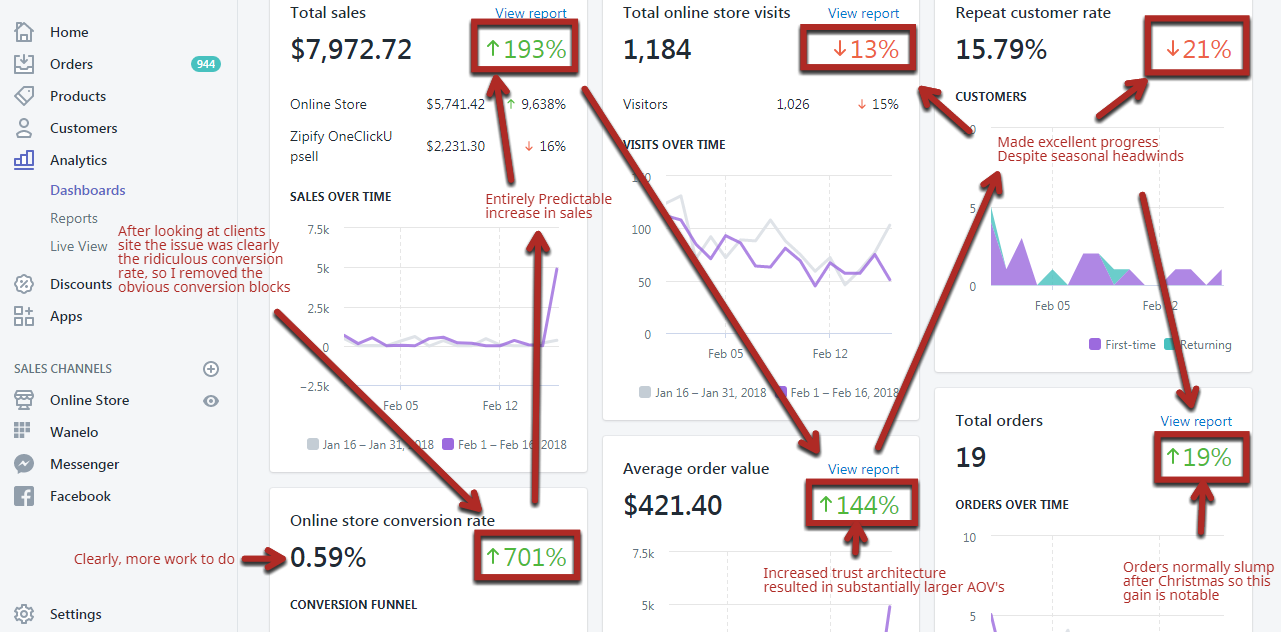
Someone who knew what he was looking at removed the obvious blocks. Nothing was tested. Nothing was optimised. That is the same work your teardown is describing.
Traffic went down. Revenue nearly tripled. That is why we fix before we optimise: there is no sense testing headlines on a page that is losing people for reasons you can already see. The group testing in months two and three only pays once the obvious losses are gone.
We walk you through every one of these on a call. You can revoke any of it in about ten seconds, and we'll tell you how.
Fast pages can't be built on most website platforms — there's a ceiling, and it's usually about half of what's possible. So the new pages we build get served from our infrastructure, on your own web address: something like offers.yourplumbing.com.
That takes one line added to your domain settings — five minutes for whoever looks after your domain. Your main website isn't touched, moved or changed. Your email is unaffected. If you ever leave, you delete that one line and take the pages with you as plain files.
We prove it before you commit: we build the first page, run it against your existing one, and compare both to your own baseline. We will not pretend a short test has settled something it can't — at your traffic, two weeks rarely separates a real gain from a good fortnight. If the evidence doesn't support keeping it, we revert or rebuild it.
This is not only about getting more out of today's clicks. It changes which keywords, services and towns you can afford to buy at all.
The same media spend produces more enquiries and more opportunities to book profitable work.
Search terms that failed at the old conversion rate can cross the profitability threshold.
Messages that convert on the page feed back into tighter ads and a more consistent customer journey.
A system that reliably turns spend into booked work makes revenue easier to forecast — and it is one of the first things a buyer looks at if you ever sell.
Use your economics, not ours. This estimate shows additional monthly gross profit before our fee.
30 additional enquiries × 45% booked × $650 gross profit.
Enough time to make a real change. Short enough to keep the decision contained. Month one is the repairs the teardown found. Month two applies wins already proven across the group. Month three is when your pages join the testing rotation — ninety days is the shortest honest window in which the mechanism can show itself.
$2,500 per month for three months · $7,500 total.
$2,500/month for three months
The group's value grows with the group. The thirtieth company to join gets fixes that took twenty-nine others to prove. So the price rises as the network does — and your rate is fixed on the day you join, for as long as you stay.
Early members are taking the risk that this works, so they pay the lowest price we'll ever charge. If you leave and come back, you come back at whatever the rate is then.
Why $2,500 and not $10,000? AI does the grunt work; humans do the judgment. That's the whole answer — the same work the big shops sell, at a cost structure they don't pass on.
The pilot ends after 90 days. Continue only if the economics and working relationship make sense.
Pages are built for your business on infrastructure you control. If we part ways, they go with you.
We agree your territory before you join. Once you join, we do not accept a direct plumbing competitor inside your territory. Our starting ceiling is one partner per 200,000 residents, and we often protect a larger area where search overlap or practical coverage demands it.
To join, you agree both to receive relevant conversion lessons from the plumbing group and to contribute applicable lessons generated by your campaigns.
You receive access to the measurement and a clear explanation of what changed and why.
Not an account manager. Not a junior "strategist". Every teardown is machine-measured and then reviewed through the lens of two decades in paid search, conversion and face-to-face selling. You are not getting agency boilerplate or a junior's opinion — and the measurement is why this is affordable at your size.
— Thousands of face-to-face sales appointments in financial services. I know how your customers decide, because I've sat across the table while they did.
— FCA-approved investment adviser (CF21), 2001–2004, at Friends Provident Life Assurance. No FCA or PRA disciplinary or regulatory action. Historic approval — I am not currently authorised — but the record is public: FCA register, ref BJW00002.
— Running Google Ads campaigns since Google was new. I speak the language your money is spent in.
— Built one of the leading marketing agencies on Elance and ran it for years — hundreds of small businesses, rated in public, paid on results.
— VC-backed founder, including co-founding an advanced property & casualty insurance marketplace. If your work is insurance-funded, I know how that money moves.
— Conversion work since before it had a name — split-testing when the tools were brand new.
Every agency says their audit is ruthless. We publish ours — the same rubric we'd use on you, re-run whenever this page changes. When we added Google's own landing-page framework to the rubric, our score dropped from 8.2 to 6.5. We published that too, failures and all. Read it →
One real result, dated honestly
A full-funnel rebuild roughly trebled the store's conversion rate. Client results from this plumbing business will be added as they are earned, with their original baselines.
Screenshot and date to be addedPrior paid-search operating result
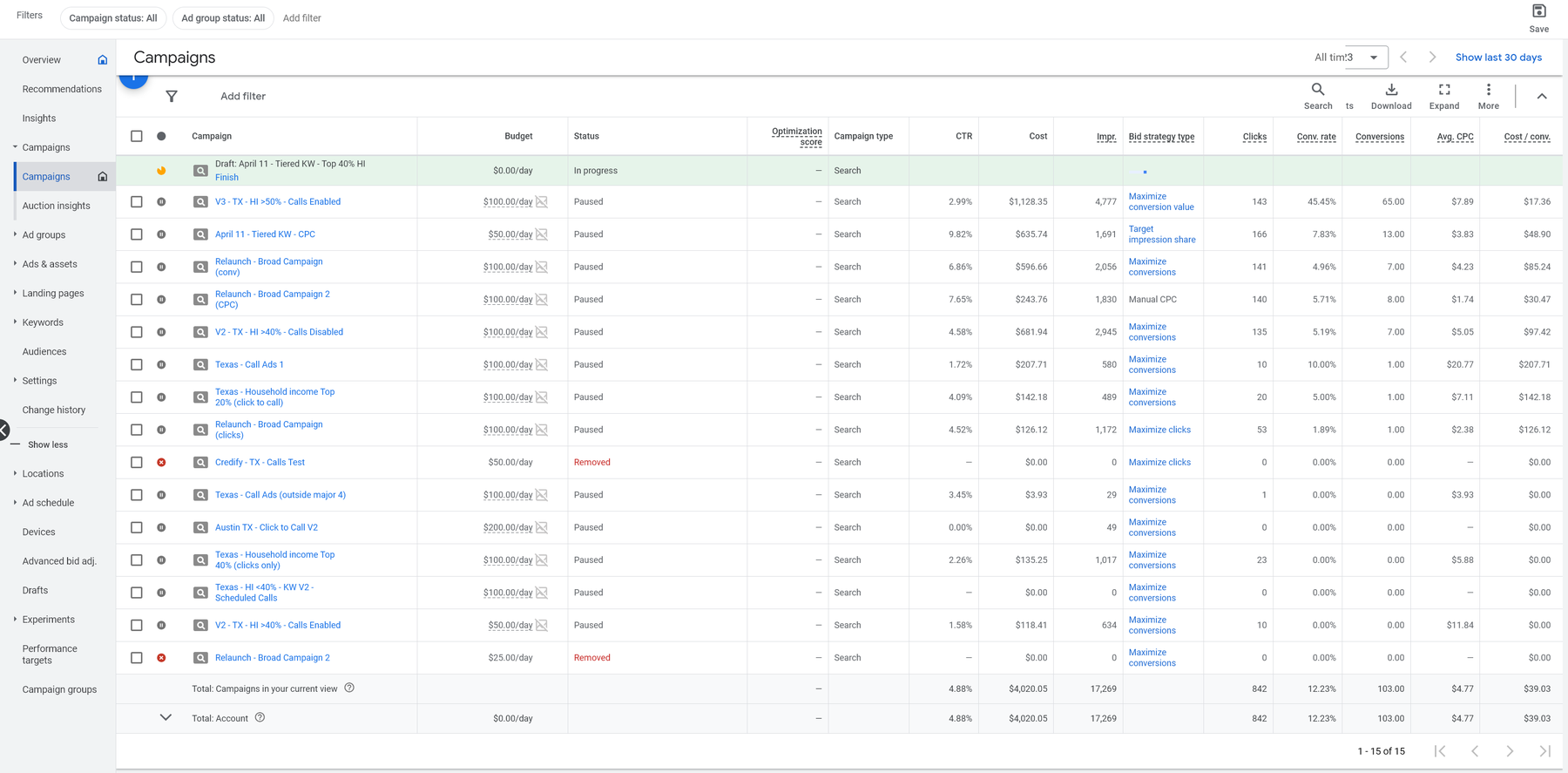
Credify, a US fintech. Google Ads, my own account. Not a plumbing result. The later campaign had calls enabled and produced far better conversion economics — but other settings differed too, so this is evidence of operating experience, not proof that one change caused all of it. It is also the same thing your teardown flags about your phone number.
Two campaigns in the same account. The later one had calls enabled. Conversion rate went up almost nine times and each conversion got 82% cheaper — on an account that spent four thousand dollars in total.
Public profile capture · dates · project outcomes
Client screenshots · baselines · resulting conversion multiples
Before/after analytics · traffic volume · changes made
Reserved for cohort results with original baselines
The first month or two will move your numbers most. The big, broken things are the big, fast wins — and they're the easiest to prove. After that, testing alone, the easy wins run out and the next answer needs more traffic than one plumbing company has. That's the point where most companies quietly stop improving — and it's exactly the point where the group starts paying for itself, because the next thing worth trying is something another market has already proved. The curve flattens for a business on its own. It doesn't flatten for you.
And some tests won't work. Across thirty companies, plenty of good ideas turn out to do nothing at all. When that happens we'll tell you plainly, we won't dress it up as a win, and we won't quietly leave it running.
Your monthly report leads with the total we've recovered since we started — not a hand-picked good week. Cumulative, against your own baseline from day one.
You have already read yours. This anonymised example is here for one reason: so you can see the method is the same every time — measured evidence, the commercial consequence, credit for what already works, and a practical order of attack. This particular advertiser was an extreme case. Yours does not need to be anywhere near as bad to be worth fixing: the money leaks at four seconds, not just at forty.
Public-facing page analysis only. No Google Ads account review or access.
Speed, mobile experience, message continuity, trust and conversion-path observations are shown with the evidence behind them.
EvidenceEvery finding connects the page problem to the decision a paid visitor is trying to make.
ImpactThe report separates urgent week-one fixes from improvements that belong in the following weeks.
PriorityThe example recognises strong tap-to-call setup and emergency-intent alignment instead of manufacturing criticism.
HonestyUse it yourself, give it to your current supplier or discuss the findings with us. There is no obligation.
YoursThis is a working session about what your teardown found, what the highest-value fix is likely to be, and whether your protected territory is available. It is not a Google Ads account review and it is not a generic agency pitch.
Compare the anonymous teardown example
If you pass, there is no drip sequence and no "just checking in" follow-up.